
Evolved Beginner
The Evolved Beginner Program differs from the Competition Beginner Program in several important ways. The most obvious is the addition of a third training day.
That third day serves several purposes. First, the additional commitment begins to reinforce that weightlifting is becoming an actual sport, not simply a hobby or a support activity for another "primary" sport. The athlete is beginning to identify themselves as a weightlifter and treat training accordingly.
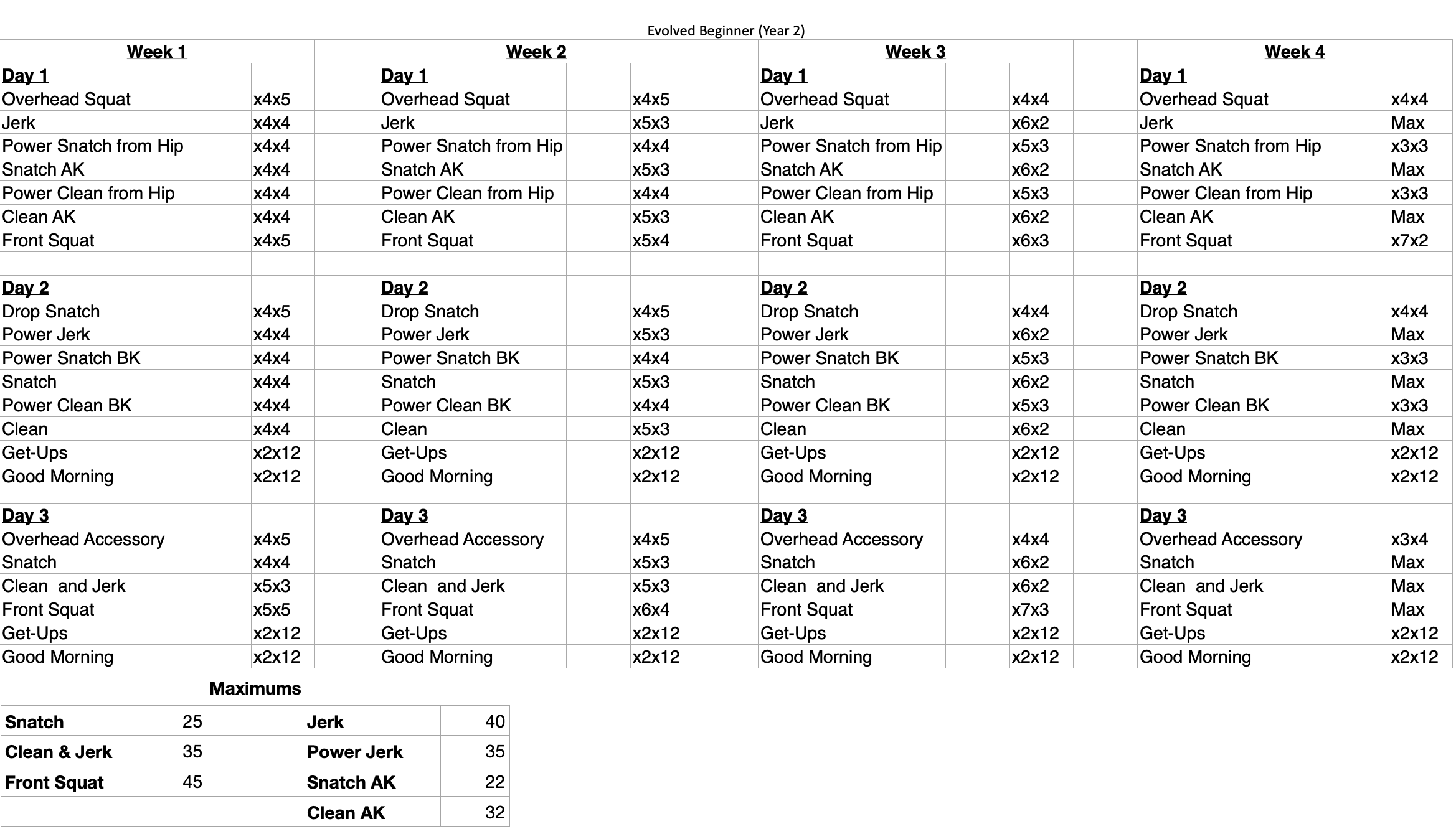
The third day also increases the athlete's overall training volume. This is an important characteristic of the Sandusky system, and one that becomes increasingly evident as athletes progress through our programs: we generally increase volume by increasing the number of training sessions per week rather than dramatically increasing the amount of work performed in any single session.
The third day also has a more direct competition focus. There is relatively little assistance work, allowing more of the session to be devoted to practicing the competition lifts and developing the athlete's ability to perform them consistently. At the same time, we are preparing the athlete for how training will evolve in future programs.
The First Two Days
The first two days remain very similar to the Competition Beginner Program. The primary focus continues to be learning and refining the competition lifts, with additional repetitions in the supporting exercises, including good mornings and get-ups.
The athlete is still developing technically, so repetition remains an important part of the program. We are not simply adding weight and assuming that development will take care of itself. The lifts continue to be practiced frequently while the athlete gradually becomes stronger and more capable of handling increased training volume.
The Third Day
The third day begins with an overhead accessory movement, selected by the coach based on the individual needs of the lifter. From there, the majority of the session is devoted to the lifts identified in the program's Maximums section.
These maximums are progressed in a linear fashion.
As always, the term "maximum" needs to be understood within the context of the Sandusky system. These are not true one-rep maximums. They are generally kept around 80% of what the coaches believe the athlete could actually lift if their technical skill matched their physical strength.
At this stage, the lifts we are looking to establish new training maximums in include:
Snatch
Clean & jerk
Front squat
Jerk
Power jerk
Snatch from above the knee
Clean from above the knee
Why Above-the-Knee Lifts Are Used as Maximums
The snatch and clean from above the knee are particularly useful at this stage because the athlete can generally handle more weight from these positions.
By starting with the bar already in the power position, the lifter is able to express more of their physical strength without requiring the same amount of technical skill needed to successfully execute the lift from the floor.
This makes the above-the-knee variations useful as a measure of the athlete's developing strength. Even here, however, we maintain the same conservative philosophy. The "maximum" is still generally kept around 80–85% of what we believe the athlete could truly lift.
The goal is to give the athlete exposure to heavier weights while maintaining a meaningful margin of safety.
Still No Back Squats
At this stage of development, we still do not use back squats in training.
The focus remains on developing the front squat, which has been part of the athlete's training since the beginning. We want the athlete to continue building the strength and positions necessary for the competition lifts without introducing additional exercises simply because the athlete is getting older or stronger.
The back squat will eventually be introduced, but not until the next and final Evolved Beginner program, as the athlete continues progressing through the Sandusky system.
The Evolved Beginner Program is therefore an important transition point. The athlete is training more frequently, accumulating more volume, practicing competition more deliberately, and beginning to work with heavier training maximums—all while the coach continues to maintain the conservative loading philosophy that protects the athlete's long-term development.