
Evolved Beginner Transition (To Year 3)
The final program in our two-year Beginner training system is the Evolved Beginner Transition Program. Its purpose is to bridge the gap between the beginner stage and our 13U training programs.
At this point, the lifter has spent two years learning the competition lifts, developing their technique, learning how to compete, and gradually increasing their training frequency and workload. Now we begin introducing exercises and training concepts that will become important parts of their future programs.
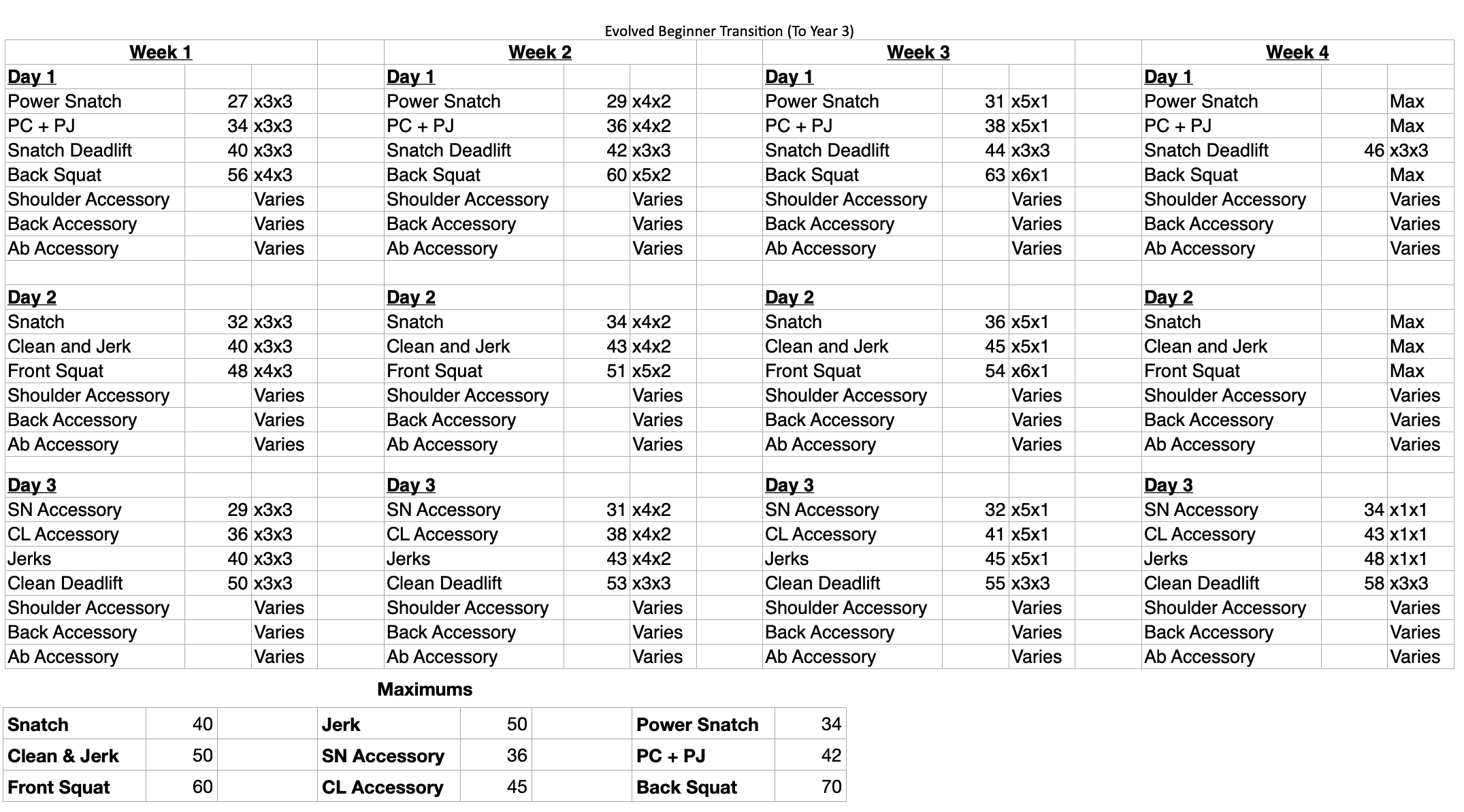
Among the new movements introduced are the classic lifts, power snatch, power clean & power jerk, snatch deadlift, clean deadlift, and back squat. All of the sets and reps listed are to be performed with the top weight listed in each exercise.
Learning to Pull
One of the most significant changes in this program is the introduction of pulling-specific exercises.
Up until this point, we have intentionally used no pulling-specific exercises in our training.
This is deliberate.
In the early years of development, we want the snatch and clean to be learned as complete, holistic movements. We do not want young lifters thinking of the lifts as simply pulling the bar higher and then dropping underneath it. Instead, we want them to learn to move their bodies around and under the bar as one fluid movement.
The goal is not to teach the athlete to "pull up" and then descend under the bar. The goal is for them to understand the snatch and clean as a single coordinated movement.
Once that foundation has been established, we can begin isolating portions of the movement. The introduction of the snatch and clean deadlift allows us to specifically develop the pulling muscles and reinforce the positions required during the first portion of the competition lifts.
Snatch and Clean Deadlifts
The deadlifts follow a simple four-week progression:
Week 1: 100%
Week 2: 105%
Week 3: 110%
Week 4: 115%
All deadlifts are performed for 3 sets of 3 repetitions.
We never take the deadlift to a maximum.
The percentages are based on the athlete's competition lift, but it is important to remember that the competition-lift "maximums" we use in our system are themselves deliberately conservative—generally around 80–85% of what the athlete could actually lift if their technical skill matched their physical strength.
As a result, even the 115% deadlift in Week 4 remains a reasonable training load for 3 sets of 3. The purpose is to develop the pulling strength and positions we need, not to see how much the athlete can deadlift.
Introducing Percentage-Based Training
This program also introduces a more formal system of percentage-based training.
The primary progression is:
Week 1: 80%
Week 2: 85%
Week 3: 90%
Week 4: Maximum week
As with all of our previous programs, the word maximum needs to be understood in context. These maximums should still generally represent only 80–85% of the athlete's actual potential.
This philosophy applies to the squats as well. Even when working toward a maximum in the front squat or back squat, we do not want young lifters grinding out heavy repetitions simply to establish a new PR.
The goal is controlled progression and continued development—not testing the limits of the athlete's strength.
Day 3: Addressing the Athlete
The third day of the program is intentionally different.
It serves as a day for the coach to address technical or strength issues specific to the individual lifter. This is why the template contains placeholders for snatch and clean accessories rather than prescribing a specific exercise.
The coach determines which movements are most appropriate based on what the athlete needs.
The "maximum" listed for these accessory lifts is set at approximately 90% of the corresponding competition lift. These exercises are never performed to a true maximum. Doing so would defeat their purpose.
For example, if the athlete's snatch from the floor is 50 kg, the maximum used for a related accessory might be established at 90% of that number, or 45 kg. Week 1 would then use 80% of that 45 kg training maximum.
The result is intentionally conservative.
We are using these exercises to improve technique and address specific weaknesses, not to create another opportunity for the athlete to chase a PR in a movement that is only indirectly related to competition.
Assistance Work
Each training day also includes one shoulder, one abdominal, and one back assistance exercise.
Again, these are not rigidly prescribed. The coach selects exercises based on what each lifter needs.
Sets and repetitions can vary, but the shoulder exercises generally follow a linear progression, often beginning around 3 sets of 8–10 repetitions in Week 1 and progressing toward 6 sets of 2 repetitions by Week 4.
The abdominal and back exercises generally remain higher-repetition, lighter-load movements. Their purpose is to provide additional support for the trunk and develop the musculature necessary to support the athlete's continued development.
Preparing for 13U
By the end of the Evolved Beginner Transition Program, the athlete has been gradually introduced to nearly every major concept they will encounter in the next stage of the Sandusky system.
They have learned the competition lifts, developed their own technique, learned how to compete, increased their training frequency, experienced controlled maximums, learned percentage-based training, and now have experience with pulling exercises, power variations, and back squats.
Nothing has been introduced simply because the athlete is getting older. Each new element has been added when the athlete has developed enough of a foundation to benefit from it.
The transition to 13U is therefore not a sudden change in how we train. It is the next step in a progression that has been building since the athlete first learned to snatch and clean at age 10.