
Competition Beginner
The Competition Beginner Program
Once a new lifter has completed several rounds of the Beginner Training Program and their technique has reached the proficient stage, as determined by the coach, they are ready to move into the Competition Beginner Program.
Competition Beginner Program
Click on the image to view the PDF version
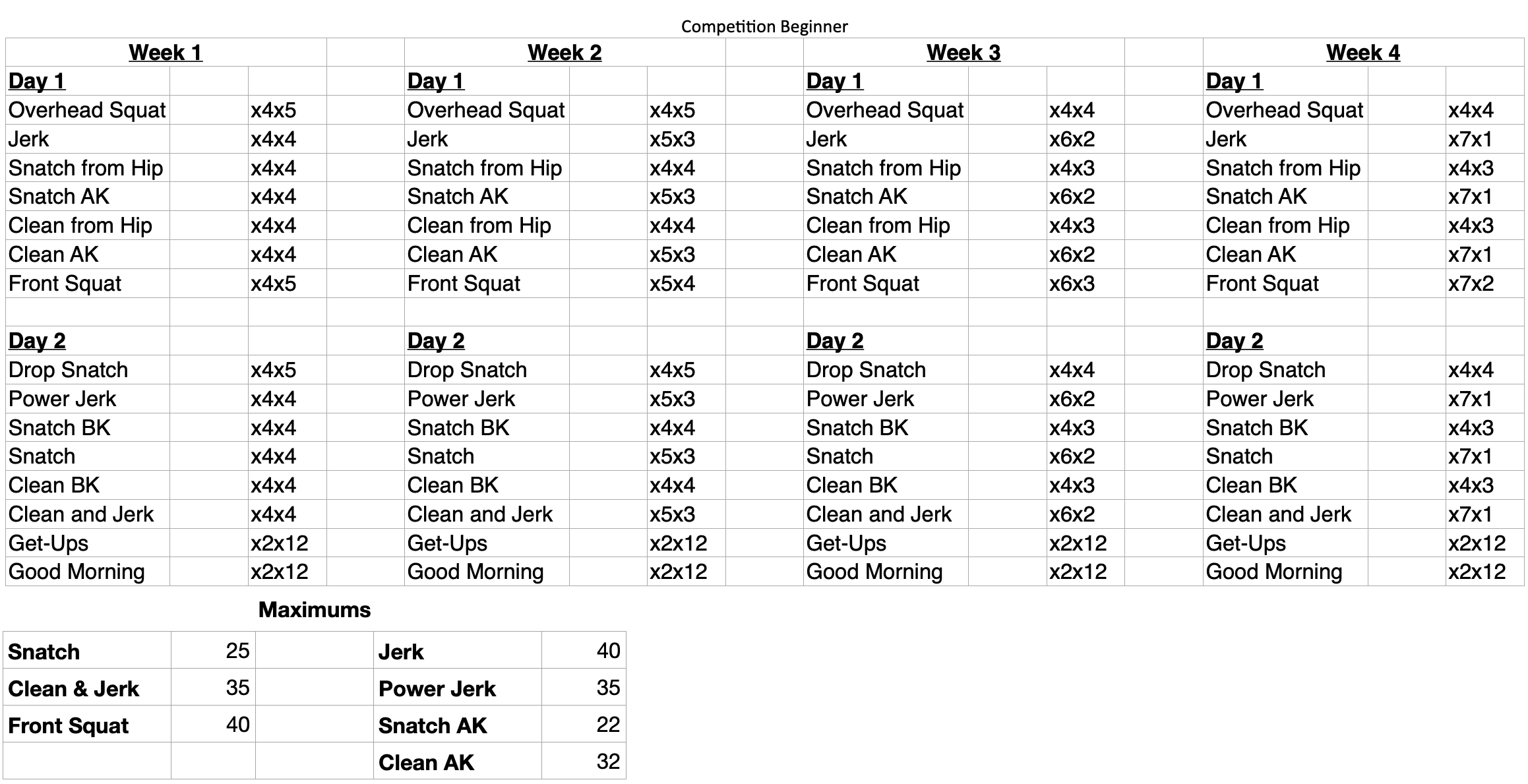
This program is still part of our Beginner, or Year 1, training system. The lifter is not suddenly expected to train like an advanced weightlifter. The weights should still remain approximately 70–80% of what we believe the athlete could lift if their technique were perfected and they were physically more mature.
The goal is still development—not testing limits.
A Simple Linear Progression
The Competition Beginner Program looks similar to the original Beginner Program, but there are several important differences.
The program selects seven lifts that will be trained using a simple four-week linear progression. The lifter begins Week 1 with four sets of four repetitions and gradually works toward a "heavy" single in Week 4.
Again, heavy is relative.
The Week 4 single is not a true maximum. We intentionally keep it lighter than what we believe the athlete is capable of lifting. At this age, the number on the bar is far less important than the experience of successfully completing the lift.
For a young lifter, setting a new PR is exciting and motivating. It gives them something tangible to work toward and encourages them to continue training hard. The PR itself is important to the athlete; the actual weight is not particularly important to us as coaches.
Small Improvements Add Up
Another important change is that we begin tracking the lifter's PRs directly on the program sheet.
When the lifter begins their next four-week Competition Beginner cycle, their previous training becomes the starting point for the next one. We encourage small, consistent progressions rather than large jumps.
For example, if a lifter completes 20 kg for 4 sets of 4 on the snatch in Week 1, their goal for the next four-week cycle might be 21 kg for 4 sets of 4.
One kilogram may not seem like much, but that is exactly the point. We want young lifters to learn that progress does not require constantly making large jumps. Small improvements, repeated over time, create significant development.
Learning How to Train for Competition
The purpose of the Competition Beginner Program goes beyond simply getting stronger. We are beginning to teach the athlete how to train for competition.
The program introduces a simple and effective concept:
Run the program. Improve your numbers slightly. Run it again. Improve them again.
At the same time, the lifter continues to develop and refine their technique through repeated sets and repetitions. The lifts are still trained using a top-down approach, allowing the athlete to continue working through the positions and reinforcing proper movement patterns.
The program also begins introducing another important concept: training toward a maximum.
The Week 4 single represents the beginning of this process. It is not a true maximum, but it allows the athlete to experience working toward a heavier single on a regular schedule. At this stage, that happens approximately once per month.
Slowly Introducing the Maximum
Our long-term goal is eventually to develop lifters who are comfortable and capable of lifting near their maximum multiple times throughout a month. But we do not try to get there quickly.
A young athlete needs years of development before they are ready for the demands of that type of training. Maximum sessions are therefore introduced slowly and progressively over years—not months.
The Competition Beginner Program is one of the first steps in that process. We introduce the concept of working toward a maximum while keeping the actual loads conservative.
The athlete gets the experience of training hard, setting PRs, and working toward heavier lifts, while the coach maintains control of the long-term development process.
That balance—allowing the athlete to feel like they are pushing their limits without actually requiring them to—becomes an important part of the Sandusky Way.