
Evolved Beginner (Year 2) Training Plan
Moving Into Year 2
When we start a new lifter at age 10, they will typically remain within our Beginner training system for the entirety of their first year. Once National Championships Week has passed, we begin transitioning them into the Evolved Beginner phase, marking the beginning of their second year of training.
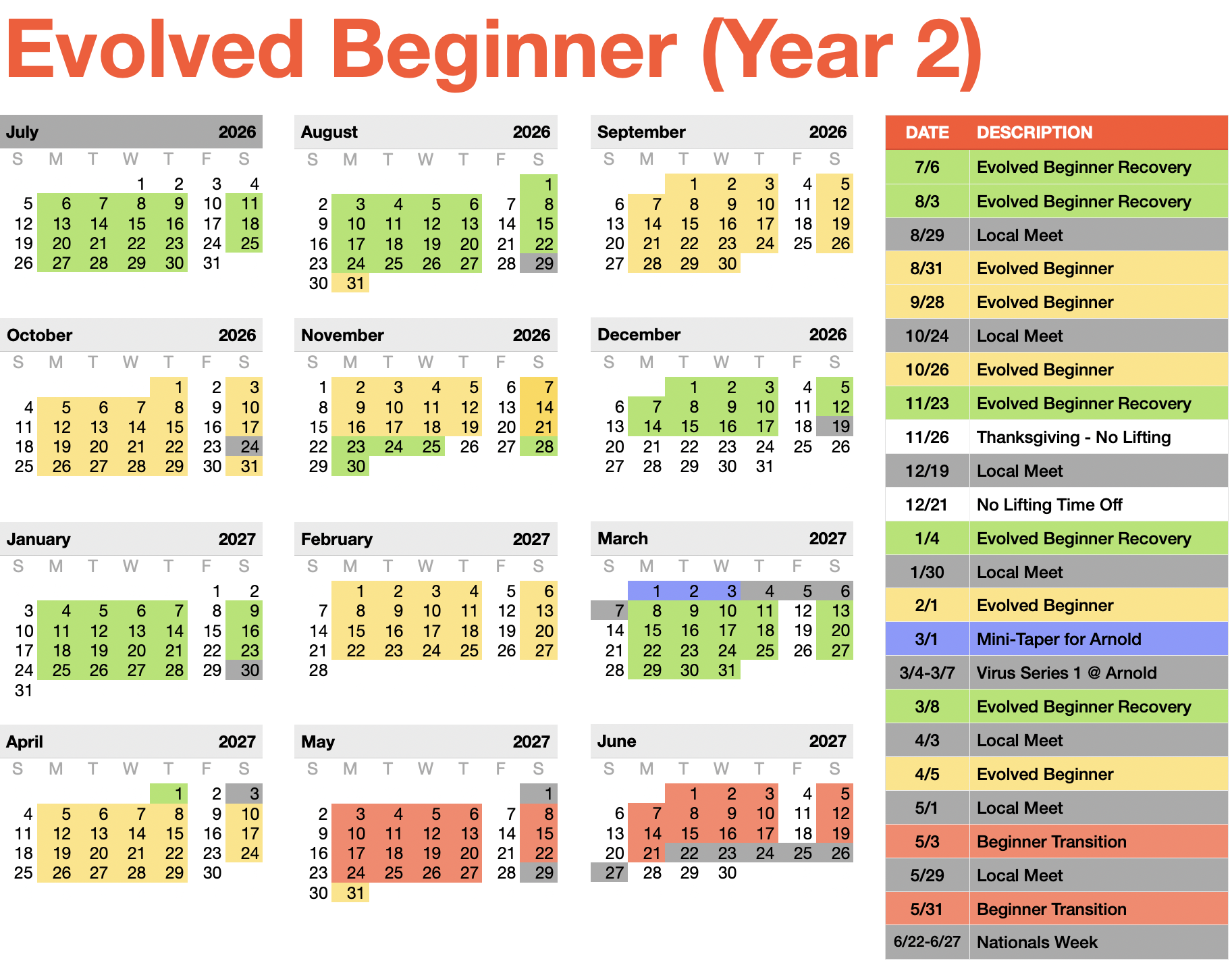
The transition into Year 2 begins with two months of Evolved Beginner Recovery Training.
Evolved Beginner Recovery
During these first two months, the lifter continues training twice per week, but the focus of the training changes.
Rather than immediately increasing training frequency, we use this period to address the athlete's individual needs. The coaches introduce different exercises and compound movements based on what they see in the athlete. This might include correcting bad habits, addressing strength gaps, or developing areas that may have been overlooked during the first year.
The Recovery Program gives us an opportunity to step back, evaluate the athlete, and prepare them for the increased demands of Year 2.
It is not a break from training. It is a period of rebuilding and preparation.
Evolved Beginner Program
After approximately two months of Evolved Beginner Recovery Training, the athlete moves to three days of training per week on the Evolved Beginner Program.
For much of the year, the athlete will alternate between the Evolved Beginner and Evolved Beginner Recovery programs. This allows us to continue developing the athlete while periodically stepping back from the normal training structure to address whatever the coach determines needs attention.
Competition remains an important part of the process. We continue to encourage frequent competition, again aiming for approximately nine competitions throughout the year. The goal remains the same as it was in Year 1: competition is not simply an opportunity to test strength, but another skill that needs to be developed through practice.
Transitioning Toward Year 3
As winter comes to an end and we move into spring, the training program changes again.
The athlete moves into the Evolved Beginner — Transition to Year 3 Program. Training remains at three days per week, but we introduce a significant new concept: percentage-based training.
Up to this point, training loads have primarily been determined by what the athlete is capable of doing from week to week. Now we begin using percentages to more deliberately manage training intensity and volume throughout the week.
There is an important detail to understand about these percentages: the maximums they are based on are still deliberately conservative.
The training maximum used to calculate percentages is generally set at approximately 80% of what our coaches believe the athlete could actually lift if their technical skill matched their physical strength. In other words, we are not treating the athlete's current best lift as their true potential, nor are we using an estimated maximum based solely on their strength.
This is intentional.
Young lifters can often produce far more force than they can effectively express through the snatch and clean & jerk. Their physical strength may develop faster than their technical skill, and allowing their training percentages to be based on their true physical potential would expose them to unnecessary loading.
By keeping the training maximum artificially conservative, we create a safeguard for the athlete. The lifter can train with enough intensity to continue developing while maintaining a margin between what they are actually capable of lifting physically and what we ask them to lift in training.
This represents another step forward in the Sandusky system. The athlete is no longer simply learning the lifts or learning how to train. We are beginning to teach them how to manage training stress and how different levels of intensity and volume fit together within a larger training plan—all while continuing to protect their long-term development.
The Transition to Year 3 Program continues through National Championships Week in June. Following Nationals, the athlete will begin a new training cycle in July, moving into our 13U training programs.
By this point, the lifter has spent approximately two years learning the lifts, developing their individual technique, learning how to compete, building a physical foundation, and gradually being introduced to more sophisticated training methods.
The next stage is no longer about simply being a beginner. They are becoming a weightlifter.