
Only the Strong Survive
I want to take some time to explain something about weightlifting.
Weightlifting is a sport that does a fantastic job of applying Darwin’s theories to the maximum. As much as we coaches like to get into the minutia of training and discuss ideas such as RPE or RIR or ZZZ, the truth is that we are searching for the genetic one-percenters who can simply survive.
In his book on three-time Olympic Gold Medalist Naim Suleymanoglu, his original coach, Enver Turkileri, states at one point that weightlifting as a sport had evolved beyond what could be done by normal humans. Those who were breaking world records were far from normal.
Below is a sample of the program I used when training my sister in 2009. At this point, she had returned home from a resident program and had worked her way back to winning the Junior Nationals with lifts of 66kg in the snatch and 90kg in the clean and jerk. She had made the junior world team, but we knew her results from Nationals were not good enough.
The decision was made to start training nine times per week during the heavy months leading up to the World Championships. Then, about one month out, we would reduce back to a more normal six-times-per-week schedule.
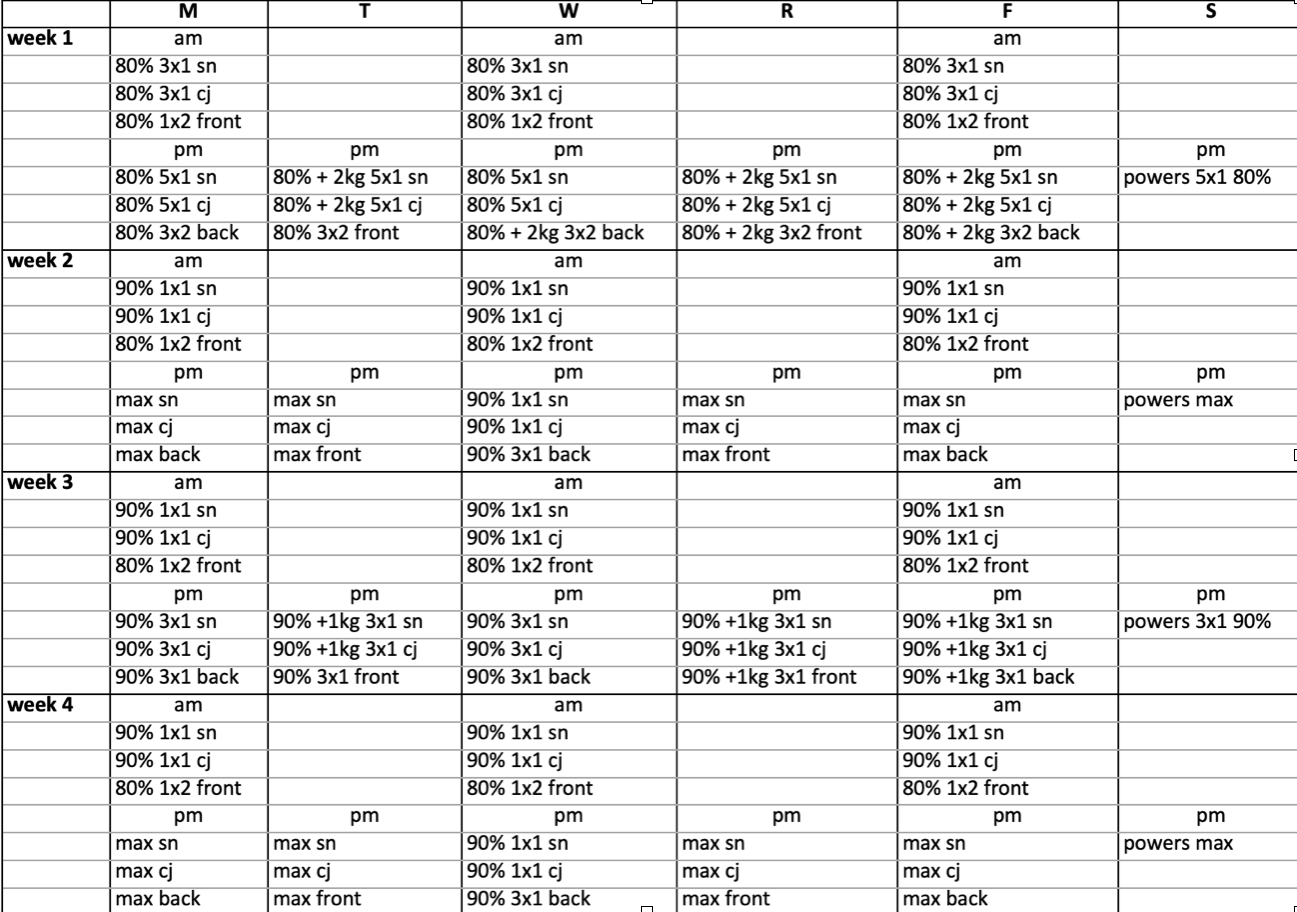
Chelsea Kyle, Heavy Training, April-May 2009
There is nothing overly “scientific” here. It requires someone who is willing to put in maximum effort on a daily basis—or, more accurately, a twice-daily basis. The lightest week of training is 80%, and that still requires a double session three times per week of 80% training. During the max weeks, the morning workouts are taken to 90%.
It was hard.
But it was effective.
At the Junior Worlds in June, she would go 5-for-6 and break five personal records. In December, after repeating this training program two more times in the fall, she would achieve her personal best in the clean and jerk of 98kg at approximately 56kg bodyweight.
In the late 2000s, I was conversing with a member of the Bulgarian National Weightlifting Team over Skype on a fairly regular basis. He spoke no English and I spoke no Bulgarian. We used Google Translate to communicate back and forth.
During one conversation, we were talking about how often someone should train. I told him that some of the top U.S. lifters at the time were training three to four days per week. While I understand there are some who can make it to the top with such little training, those are the outliers to the outliers.
His response:
“This is too little training.”
My reply back:
“Our lack of medals proves this is too little.”
His follow-up sums up weightlifting training perfectly.
“Exercise more and there will be more medals.”
Is training at a high level of intensity and frequency unreal? Too difficult?
Let’s compare weightlifting to another popular sport in high schools: swimming.
You’d be hard-pressed to find a swim program that does not go year-round but also has their swimmers training twice per day during the season—and, from what I’ve observed, usually right up until the postseason.
This is not reserved for the competitive elite. It is usually just something everyone on the team does. It may be deemed “optional,” but there is a clear asterisk on that optional term.
We could discuss whether this level of volume training is developmentally appropriate, but nevertheless, volume is volume. And if a random crop of high school students are expected to train with double days worth of volume, it suddenly makes training weightlifting twice a day seem perfectly reasonable.
At least in weightlifting, you can control the amount of weight on the barbell.
If you’re tired, reduce the weight.
In a sport like swimming, 300 laps is 300 laps.