
13U Recovery Light
The Recovery Light Program is designed to be used following Nationals, usually after a week or two of no training. A shorter version of the program is also used at the midpoint of the training year, typically in late November or early December.
The purpose of the program is to address weaknesses and technical flaws while slowly beginning to build back toward heavier weights. This is not a program designed to maintain the intensity of competition training. It is a deliberate step back that allows the lifter to recover while rebuilding their training base.
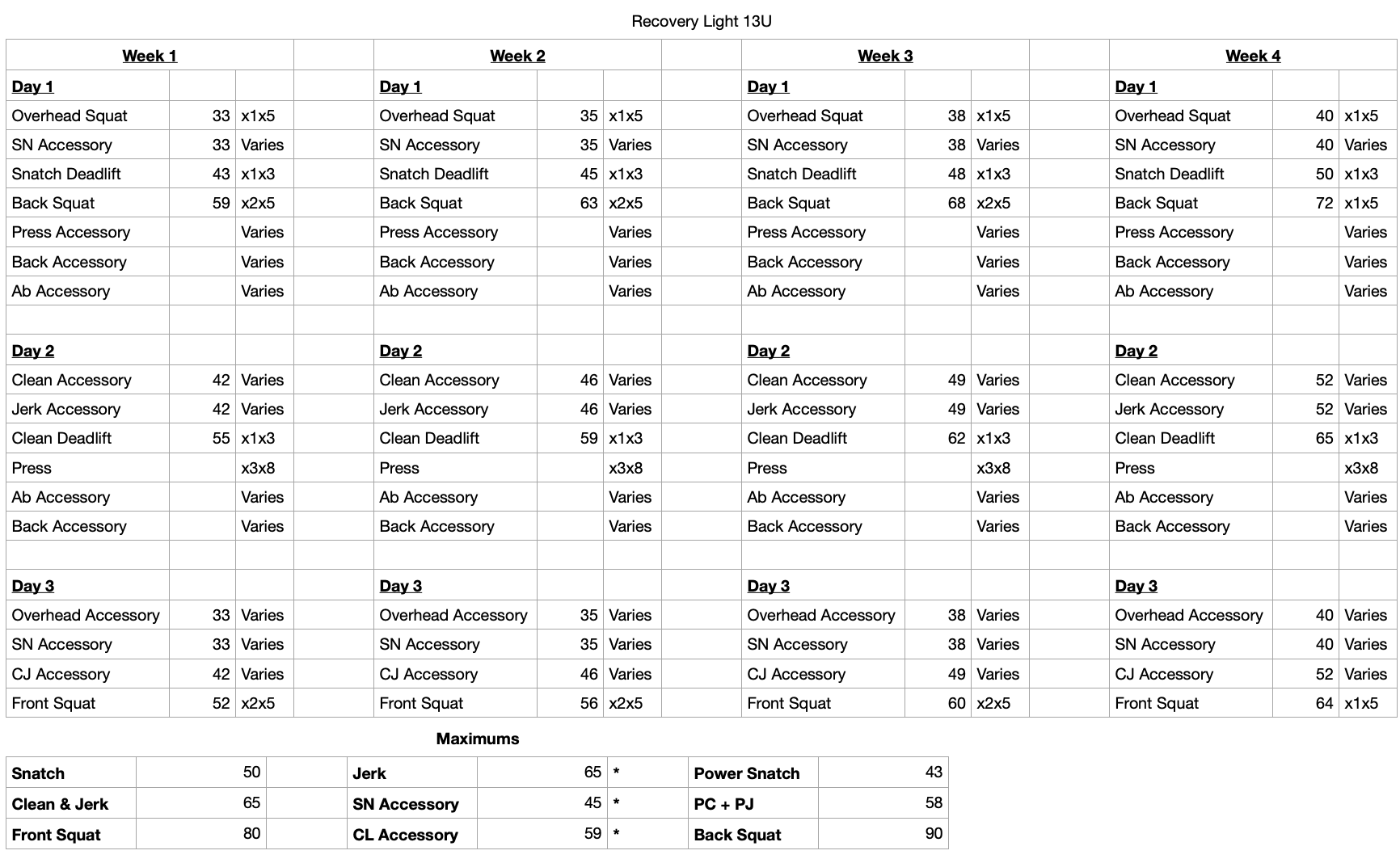
You will notice that most of the exercises, with the exception of the squats and deadlifts, are labeled as “accessory.” This simply means that a variation of the movement will be selected by the coach based on what the lifter needs. For example, a snatch accessory could be a hang snatch, a complex, a power snatch, a variation from blocks, or another movement the coach feels is appropriate to address a perceived technical flaw or weakness.
Two of the training days also include accessory work for the back, shoulders, and abdominals. Snatch and clean deadlifts are still performed, but with significantly less volume than in our normal training programs.
The squat work is also intentionally different. Instead of the triples, doubles, and singles that are preferred during the Competition Prep and Competition phases, the Recovery Light Program uses sets of five. The goal is to accumulate quality work without the higher intensity associated with competition preparation.
Across the three training days, one day focuses primarily on the snatch, one day focuses primarily on the clean & jerk, and the third day combines both lifts.
The four-week progression begins at approximately:
Week 1: 65%
Week 2: 70%
Week 3: 75%
Week 4: 80%
The goal is to take our time and slowly rebuild the base. There is no need to rush back to heavy weights. The lifter has just come through a demanding training and competition period, and this program gives them the opportunity to recover while gradually preparing their body and technique for the next phase of training.