
13U Competition Prep
The 13U Competition Prep Program is where our training programs begin to mature. At this point, we introduce a second day of intensive practice of the competition lifts, along with a second day of front squatting, bringing the total to three days of squatting per week.
The competition lifts and squats follow a four-week intensity pattern:
Week 1: 80%
Week 2: 90%
Week 3: 85%
Week 4: Maximum week
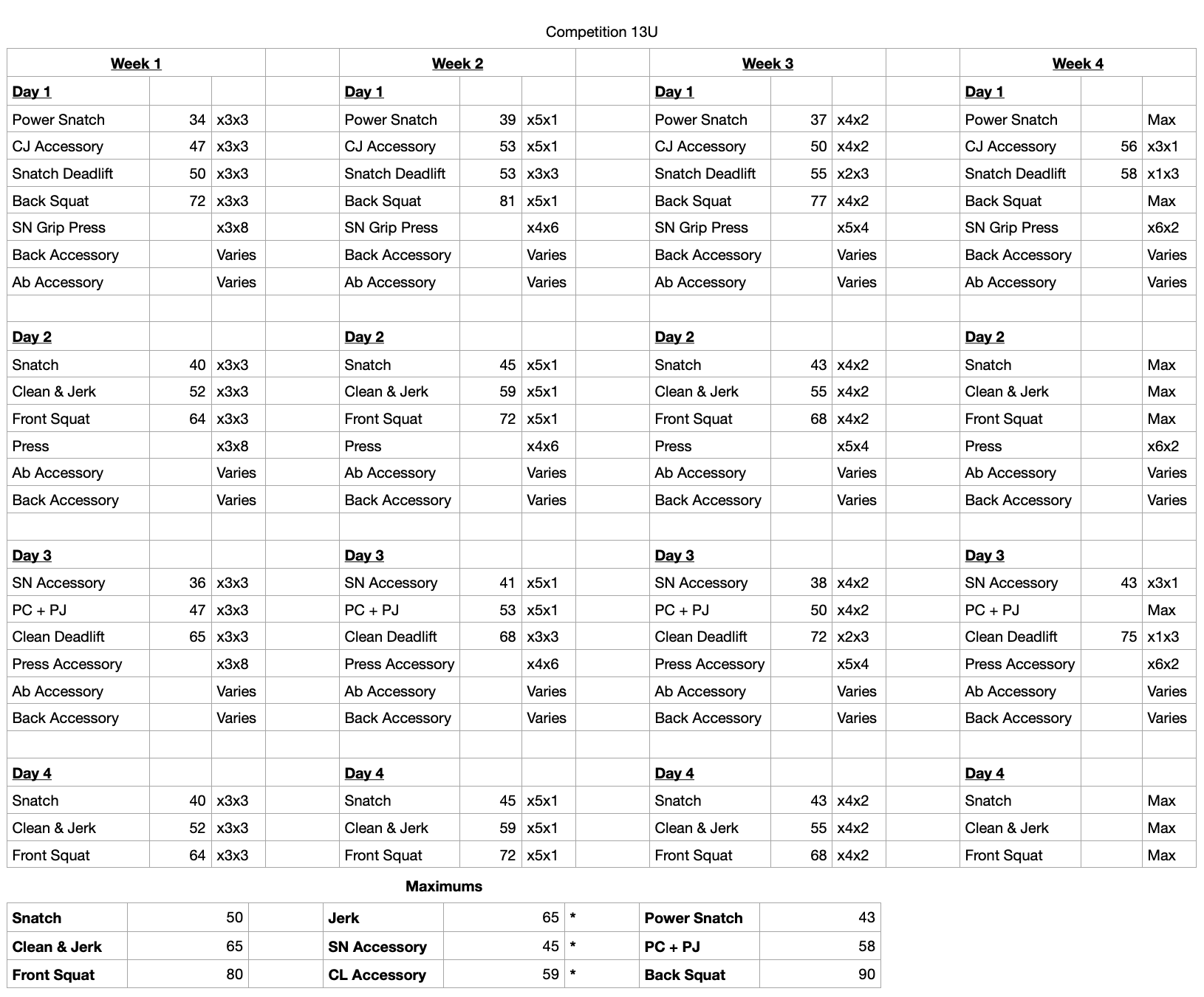
It is important to understand that even during Maximum week, we are not asking the lifter to reach their true physical limit. The weights lifted are generally around 90% of what the athlete could truly do if pushed to their maximum capability. We want them to experience heavy training and continue developing confidence under heavier loads without routinely pushing them to their actual limits.
While intensity follows this pattern, volume follows the inverse pattern. The 80% and 85% weeks contain the most volume, while the 90% and Maximum weeks contain less volume.
This approach developed from our early experiments with structuring the weightlifting season in the late 2000s. At that time, we were holding competitions every two weeks and wanted those competitions to fall at the end of either a 90% week or a Maximum week.
Alternating between lower-intensity, higher-volume weeks and higher-intensity, lower-volume weeks proved to be an effective way to keep training fresh. It also provided enough variation to complement our preference for specificity in training. We wanted to practice the competition lifts frequently while managing the volume and intensity in a way that allowed lifters to continue making progress.
Variation Days
The two training days opposite the intensive competition-lift days are built around variations of the snatch and clean & jerk.
Each day includes:
One snatch or clean accessory variation
Either a power snatch or a power clean & power jerk
The power movements follow the same weight and repetition pattern as the competition lifts. The accessory lifts can use different repetition schemes, but they follow the same weekly intensity pattern.
There is one important distinction with the accessory movements: their training maximums are based on 90% of the corresponding competition lift. During Maximum week, the lifter does not attempt a true maximum in these variations. Instead, they work up to that established 90% limit.
The purpose of these exercises is to address weaknesses and improve technical proficiency, not to establish PRs in movements that are not directly correlated to competition performance. We want the coach to have the flexibility to select variations that address what each lifter needs without turning those exercises into another opportunity to test strength.
Snatch and Clean Deadlifts
The two variation days also include snatch and clean deadlifts.
These follow a four-week progression based on the athlete's competition lift:
Week 1: 100%
Week 2: 105%
Week 3: 110%
Week 4: 115%
All deadlifts are performed for one to three triples at the top weight. We never attempt a maximum in these exercises.
The purpose of the deadlifts is to develop pulling strength while reinforcing proper positions and technique. Because the loads are based on the competition lifts and remain within a controlled range, we can continue building strength without spending unnecessary energy on an exercise that is less directly correlated to competition performance.
Assistance Work
Days 1 through 3 are finished with accessory exercises for the shoulders, back, and abdominals. These movements provide additional work to support the competition lifts and address the physical demands of weightlifting.
We also include both snatch-grip presses and regular presses in the program. Every lifter performs each of these exercises once per week.
These exercises round out the program by providing additional shoulder and upper-body strength work alongside the more specific training of the snatch, clean & jerk, squats, and pulling movements.
The Purpose of Competition Prep
The 13U Competition Prep Program brings together many of the concepts introduced throughout the earlier stages of the Sandusky system.
The lifter is now practicing the competition lifts intensively twice per week, squatting three times per week, and using variations to address individual technical and physical needs. Volume and intensity are deliberately alternated to provide enough training stimulus while allowing the lifter to recover and continue progressing.
This is where the lifter begins to experience a more mature approach to weightlifting training: specific practice, planned variation, and deliberate management of volume and intensity.